
Central SA
Hung councils could deepen municipal instability after elections─── KEKELETSO MOSEBETSI 11:25 Mon, 05 Oct 2026

Coalition politics could bring greater instability to municipalities after the 4 November local government elections.
Speaking to OFM News, North-West University political analyst André Duvenhage said a growing number of hung councils and the increasing presence of smaller parties could complicate the formation of stable local governments. He expects more municipalities to require coalitions or other governing arrangements if no party wins an outright majority.
Duvenhage warned unstable coalitions could worsen existing governance problems, particularly in municipalities already struggling with political disputes and weak administration. Several coalition-run councils have experienced instability since the 2021 local government elections, with shifting alliances and repeated changes in political leadership affecting continuity in some municipalities.
The Coalition Barometer II (2023–2025), compiled by the Mapungubwe Institute for Strategic Reflection, also identified significant challenges in coalition-led municipalities. The report found provinces such as Limpopo and the Eastern Cape were less affected because the ANC retained outright control in most municipalities, limiting the need for coalition governments.
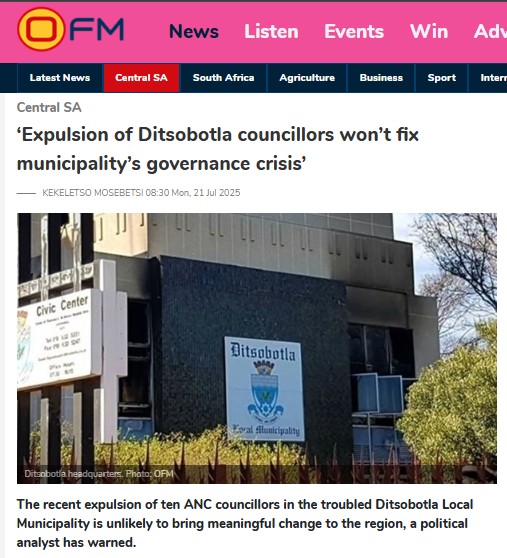
The North West presents a somewhat different picture. Political instability in several municipalities has often resulted from internal disputes, factionalism and governance breakdowns rather than coalition collapses alone, as the ANC has retained majority control in many councils. Ditsobotla is among the municipalities associated with prolonged instability and disputes over political leadership.
He also addressed the argument that supporting smaller parties amounts to wasting a vote. South Africa’s proportional representation system allows smaller parties to gain council representation according to the level of support they receive, while ward votes also form part of calculations determining proportional representation.
“We have a proportional representative system; therefore, a vote can never be a loss in the process. Even when you look at the ward side, when you calculate the proportional list side, the ward votes are brought into the calculation, so you cannot lose a vote. The system is in fact accommodating smaller parties.”

The issue has become part of the political debate ahead of the elections. ActionSA rejected calls for voters to concentrate their support on larger parties, criticising DA federal council chairperson Helen Zille’s argument that voters should avoid “wasting” votes on smaller parties. The party says voters should remain free to support alternative parties and independent candidates.
Build One South Africa leader Mmusi Maimane has made a similar argument, saying voters should reject the idea that choosing a newer or smaller party automatically amounts to throwing away a vote. He maintains proportional representation enables support to translate into representation according to the number of votes a party receives.
Duvenhage said the growing fragmentation of the political landscape could nevertheless have consequences after election day. Where councils are closely divided, negotiations between parties are likely to become increasingly important, while the durability of those agreements could determine whether municipalities gain greater stability or face another period of shifting political control.
OFM News/Kekeletso Mosebetsi dg
• Have a news tip to share? Phone or whatsapp the OFM News Hotline: 066 487 1427.