Click on the warning image to view this post

Click on the warning image to view this post
Click on the warning image to view this post
Off-Beat-News
11 Questions about Ebola answered (graphic images)─── 10:49 Tue, 05 Aug 2014

The worst outbreak of Ebola virus in history - happening now in West Africa - has claimed more than 700 lives, according to the latest count from the World Health Organization. The deaths occurred in Sierra Leone, Liberia, Guinea and Nigeria.
What is Ebola?
Ebola virus disease was named after the river in the Democratic Republic of the Congo, where one of the first two villages to report cases in 1976 was located. The other was in Sudan. Ebola is a severe viral illness with a sudden onset that comes from direct contact with infected living or dead rainforest animals, including chimpanzees, gorillas, monkeys, fruit bats, forest antelope and porcupines. It kills up to 90% of those who are infected.
The virus is passed from one human to another, carried in blood and bodily fluids and secretions, but also beds, sheets, clothes or other surfaces that a sick person has touched. Burial ceremonies that involve touching the body are also a risk. The virus enters the body through broken skin or mucous membrane.
The group at highest risk are health workers, caring for those with Ebola. They have to wear full protective clothing, including facemasks and goggles, and should change their gloves between one patient and the next.
The early signs are sudden fever, intense weakness, muscle pain, headache and a sore throat. Vomiting and diarrhoea follow, raising the chances that the sick man or woman will infect somebody else. The kidney and liver are affected and there can be both internal and external bleeding, which is why it was originally called Ebola haemorrhagic fever. Patients are infectious once the symptoms show, which is two to 21 days after they have contracted the virus.

What is the treatment?
There is very little treatment. Patients will need intensive supportive care, with intravenous fluids or oral rehydration salts. They must be kept in isolation and their nurses and visitors must wear full protective suits. There are no drugs to treat the disease or vaccine to prevent it, although research on a vaccine is under way.
It has proved very hard to find drugs to treat viral diseases from animals, from influenza to HIV. Although the death rate is high, outbreaks of Ebola are infrequent and have so far been contained each time. As with many of the so-called neglected tropical diseases, there is not a potentially lucrative market for drug companies, so they will be reluctant to invest in research and development.
Will I die from Ebola?
The current Ebola outbreak has had a survival rate of about 40 percent, as per the World Health Organization. And good medical care can help people survive.
There are five types of Ebola viruses. The one that's causing the current outbreak (Zaire ebolavirus) has had an overall survival rate of roughly 30% since it was first discovered in 1976.

They can be contained in human populations but the viral reservoir still exists in animals. There will always be a risk that hunters will kill infected animals or that people will pick up those that have died of the infection in the forest and the virus will be reintroduced to the human population.
Containment is key to the strategy against Ebola. Quarantine has been used in some outbreaks for the relatives of people who become sick. Because people are not infectious until they become obviously ill, it should in theory be possible to focus efforts on the community where the outbreak began. In the past, that has usually been villages in close proximity to rainforests.
Confirmation of a case in a city such as Lagos is a real concern, but transmission must involve direct contact with a sick individual, so is more likely in a family setting or a hospital. The biggest worry is probably that somebody showing symptoms will be taken to hospital where nursing staff are unprotected, because the disease is not recognised, sparking an outbreak that spreads to their families in turn.

One of the symptoms of Ebola is bloody eyes, a bleeding nose and in later stages of the disease bleeding from other orifices.
Clearly somebody infected with the virus could theoretically get on a plane and spark an outbreak – probably in a hospital – anywhere in the world. However, as with the Mers virus, which arrived in London via a patient who was taken to St Thomas' hospital, infection control measures are so stringent in more affluent countries that it is probable the virus would be very rapidly contained.
Could Ebola become a worldwide pandemic?
Ebola kills far too quickly for it to turn into a worldwide pandemic, experts say. It is a huge deal where it already lives, but there's little to no chance of it becoming a worldwide pandemic.
However, now that the virus is spreading and is in contact with large population centers, it remains possible that natural selection will give rise to strains that can be transmitted a little more easily. It is not likely to ever become as easily transmitted as, say, influenza. Or if it does, it is likely to lose virulence. The bottom line: A deadly (Black Death-like)global Ebola pandemic is extremely unlikely.
What's the most likely scenario?
This is the largest outbreak, geographically and has the largest number of victims. The most likely scenario is that it that the outbreak will fade away in the next few weeks or months. It has been suggested that spread of Ebola in an urban setting is much less likely than in a rural setting, so a spread into the large cities is thought to be unlikely.
This is the largest outbreak, geographically and has the largest number of victims. The most likely scenario is that it that the outbreak will fade away in the next few weeks or months. It has been suggested that spread of Ebola in an urban setting is much less likely than in a rural setting, so a spread into the large cities is thought to be unlikely.
(However, that scenario is the nightmare that keeps public health officials awake at night!) The main ways it spreads is from patients to health care workers and, importantly, from deceased victims to friends and family! Why? Because funeral practices in some parts of rural West Africa involve a lot of direct physical contact: touching, kissing, washing, preparing the body. These funerary practices are not observed as frequently in urban centers. Also, health care workers in urban settings will (hopefully) be more knowledgeable and better equipped than in rural settings.
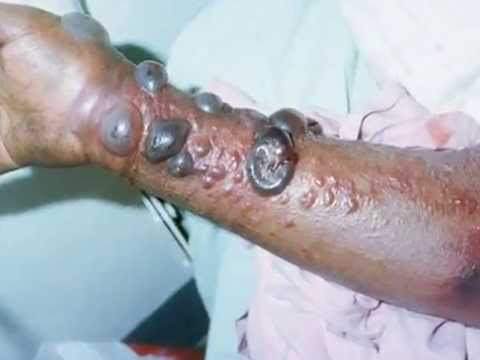
Rashes can become extreme in many cases
Sources: The Guardian, Huffington Post, Nature.com, World Health Organisation, Slate, Today, BBC, Reuters.