
South Africa
Sona 2026: Hope or hype? Experts question implementation of reform promises─── KEKELETSO MOSEBETSI 11:49 Fri, 13 Feb 2026

While many applaud the president for his optimistic state of the nation address (Sona), analysts argue only tangible results will restore hope for South Africans.
Throughout his speech, Cyril Ramaphosa outlined plans to rebuild infrastructure, strengthen state capacity and accelerate economic transformation. He emphasised a shift from what he described as a period of decline toward a more progressive phase filled with opportunity.
However, questions remain about whether these commitments will translate into meaningful change.
North-West University political analyst Prof André Duvenhage noted what he described as a centralisation of governance in Ramaphosa’s address.
“Throughout his speech, there was a tendency to centralise everything in terms of committees, commissions, or restructuring everything under command, with many things related either to ministers or the presidency,” said Duvenhage.
While Ramaphosa delivered a strong commitment to transformation and black economic empowerment, there was limited deviation toward public-private partnerships, with state control remaining dominant, Duvenhage said.
Continuation of national dialogue
“Another interesting thing to me was the continuation of the national dialogue. Then we also heard a number of things about speed trains and so on.
“To me, probably the biggest surprise was that he didn’t touch on local government elections per se.
“He did touch a lot on challenges related to local government, but not on the election itself. To me, this is an indication that there is no finalisation about the local government election scheduled for the end of the year,” he said.
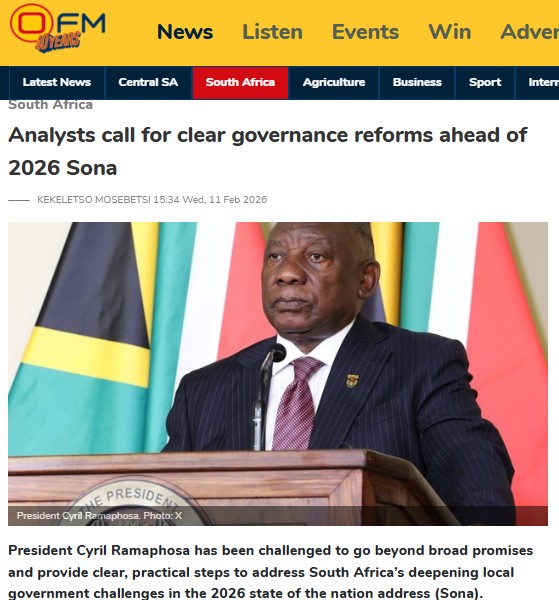
Duvenhage described much of the address as technical in nature, focusing on rebuilding infrastructure and enhancing state capacity.
“Importantly, he mentioned a turn that we are now out of the phase of decline and entering a more progressive phase full of hope for the future. My assessment of Sona is that, as with previous addresses, there was a lot of talk.
“But what will come out in practice? I have serious, serious questions about it. I don’t think the ability and the will are there to bring about the changes that were mentioned.
Throwing money at problems
“It’s not about saying the right things, he said many things correctly, although I differ in terms of political paradigm, but how you are going to execute that is going to be the main challenge,” he said.
Kedibone Phago, another NWU political analyst, echoed similar concerns, arguing the country’s challenges cannot be resolved simply through increased spending.
The president should stop throwing money at problems, as capacity and skills remain among the most urgent needs in the country, alongside ethical conduct, particularly within local government structures, said Phago.
South Africans should not applaud the country merely for hosting major international events such as the World Cup or the G20.
“The country is not run through events, nor do events resuscitate the economy and create jobs in a sustainable way. The country is run through existing institutions, to what he described as “the elephant in the room.”
Public institutions must be functional, optimal, and resilient against those who seek to weaken them for personal gain, Phago stressed. Without capable and ethical governance structures, he argued, even the most promising policy announcements will struggle to achieve lasting impact.
• Have a news tip to share? Phone or whatsapp the OFM News Hotline: 066 487 1427.