
Central SA
90 North West scholar transport operators axed over safety breaches─── KEKELETSO MOSEBETSI 14:05 Wed, 11 Feb 2026

The North West community safety and transport department has established a contingency panel of operators to prevent disruptions in learner transport, after 90 operators had their contracts terminated.
The North West community safety and transport department has established a contingency panel of operators to prevent disruptions in learner transport, after 90 operators had their contracts terminated. The current scholar transport contracts began in January 2024 when 449 operators were appointed.
But over two years, one in five operators were removed for breaching their service level agreements (SLAs).
Widespread failures and violations
Responding to an SA Human Rights Commission report on Wednesday (11/2), community safety and transport management MEC Wessels Morweng said: “These contraventions include inconsistent service, abandoning the route, unroadworthy vehicles or any recklessness that may harm or put learner safety at risk.
“So far, we have terminated 31 operators in Bojanala, 23 in Ngaka Modiri Molema, 22 in Dr Ruth Segomotsi Mompati District Municipality and 14 in Dr Kenneth Kaunda district.”
The report, released on 19 January, highlighted widespread failures and alleged rights violations. The commission issued strict orders with tight deadlines after finding widespread governance failures.
Panel of operators
The report cited weak oversight, poor enforcement and governance lapses across several departments. It also found that thousands of qualifying learners are being deprived of transport, forcing them to walk long distances, arrive late for school or drop out entirely.
“We have as at the August 2024, we began a process of appointing a panel of operators as part of our troubleshooting measures,” added Morweng. “The panel has since been appointed in April and comprises 44 operators.
“These are operators who are already in the system and can be called at short notice to transport learners in case an operator abandons the route or for whatever reason that may lead to learners not being transported,” he said.
Even learners who do receive transport are often subjected to unsafe conditions, the report noted, citing overcrowded and unroadworthy vehicles that frequently break down. Morweng acknowledged the seriousness of the challenges, attributing some of the strain to rapid demographic changes and financial constraints.
“There are several causes that exacerbate the scholar transport challenges. These include new unplanned informal settlements creating a new need to transport learners who previously would not have needed transportation,” he said.
“The other challenge, which is a causal factor to the one above, is the budget shortfall. This results in depletion of the budget, leading to starting a new financial year with accruals of the previous year.”
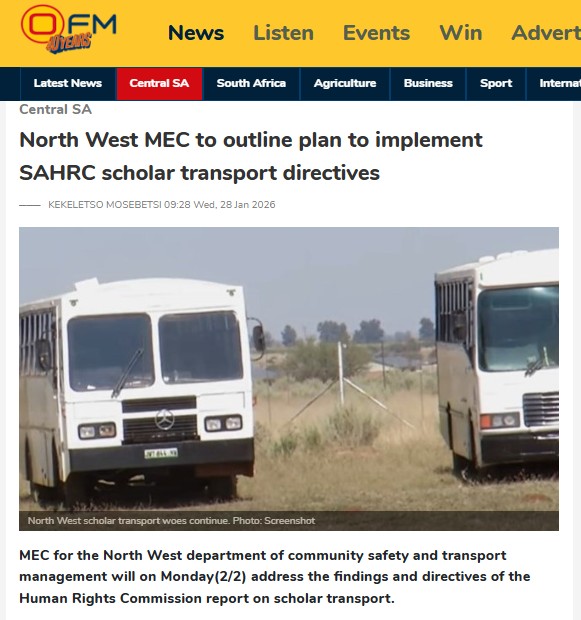
In response, the department has introduced several interventions aimed at improving compliance and stabilising the programme. A war room has been established, chaired by head of department Dr Hans Kekana, comprising officials from both the departments of community safety and transport management and of education, said Morweng.
A dedicated compliance team has also been set up to ensure operators adhere to the prescriptions of the Service Level Agreement. Buses are inspected every six months to confirm roadworthiness, while traffic officers monitor vehicles and impound them if necessary.
“Buses are also inspected every six months to ensure they are roadworthy, while traffic officers are also monitoring the buses and impound them if needs be, that is, if they are not in compliance with both the National Land Transport Act and Road Traffic Act,” he said.
ALSO READ: SAHRC demands accountability over failures in North West scholar transport
The department has engaged Provincial Treasury to increase the scholar transport budget, which stands at R460m annually. At least R610m is required to adequately service routes and avoid starting a new financial year with accumulated debt, said Morweng.
He also addressed reports, attributed to the SAHRC findings, that more than R1bn had been paid to service providers for services not rendered.
“Let me quote what the report says. On page 31 of the report, the HRC quotes the Provincial Treasury HOD, Ndlela Kunene, when explaining the budgeting for scholar transport,” Morweng said.
“And I quote it; ‘the budget allocation for scholar transport had risen from R300m to R450m in 2023/2024, totalling R1.35bn over the MTEF period. Despite this increase, the NW Provincial Treasury had observed underspending in 2022/2023, 2023/2024 and 2024/2025, mainly due to ‘the late submission of invoices’.”
Morweng clarified the medium-term expenditure framework (MTEF) refers to a three-year rolling budget cycle, in this context covering the period between 2022 and 2025.
He emphasised the department’s annual scholar transport budget is R460m, which amounts to approximately R1.3bn over three years, as reflected in the commission’s report. The SAHRC report did not come as a surprise but a confirmation of what the South African National Small Bus Operators Council has been saying all along, said its provincial chairperson, Final Kgodumo.
• Have a news tip to share? Phone or whatsapp the OFM News Hotline: 066 487 1427.