
South Africa
Experts warn night driving 60% more dangerous─── ZENANDE MPAME 12:38 Fri, 24 Jul 2026

Experts warn night-time driving is 60% more dangerous than daytime trips, with the highest collision risk occurring between 01:00 and 05:00.
As businesses increasingly rely on overnight transport to meet growing demand for e-commerce, retail replenishment and cold-chain logistics, road safety specialists say fleet operators need to rethink how they schedule drivers to reduce fatigue-related crashes.
New research by Optix Intelligence, based on nearly nine million driver-hours collected over twelve months, found that collisions are significantly more likely in the early morning hours, despite fewer obvious risky driving behaviours.
The findings come as transport minister Barbara Creecy intensified efforts to improve road safety following several fatal crashes that have placed accountability on the national agenda.

“Although collision risk is highest during the early hours of the morning, we found that there were often no high-risk driving behaviour before a crash occurred,” said Optix Intelligence head Heidi de Jager. “That tells us fatigue can cause an incident without the usual warning signs.
“South Africa’s road conditions make night driving even more challenging. Poor lighting, pedestrians, livestock, slow-moving or stationary vehicles all reduce the time drivers have to react, especially those operating large commercial vehicles.
“The economy cannot stop night-time transport, but businesses can reduce the risk. Better scheduling, adequate rest, driver rotation, safer route selection and using data to coach drivers can all help ensure more people get home safely.”
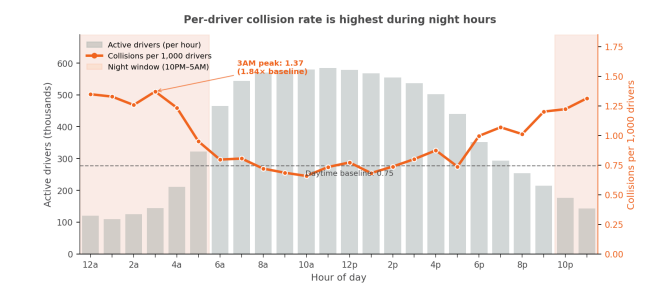
The graph shows the relationship between driver volume (bars) and the per-driver collision rate (line)across each hour of the day. The night window (10PM–5AM) is shaded. Photo: Optix telematics data
Fatigue is a condition, not a behaviour. It's not something we can blame the driver for. During the day, risky behaviour often provide an opportunity to intervene, but at night a fatigue-related collision can happen before anyone realises there’s a problem, she said.
The research attributed the increased danger to the body’s natural circadian rhythm. A circadian rhythm is your body’s natural internal biological clock. It operates on a 24-hour cycle, regulating essential functions like sleep-wake patterns, hormone release, body temperature, and digestion in response to environmental cues like light and darkness.
Human alertness, reaction time and decision-making decline between approximately 02:00 and 06:00, when the body is biologically programmed for sleep.
Even though just 15.1% of driving hours take place between 22:00 and 05:00, the study found that there is a disproportionately high collision risk at this time. The window between 01:00 and 05:00, when 6.6% of drivers are on the road during the body’s sharpest circadian peak, is the most concerning.
“We know the economy cannot stop businesses from operating at night, but companies can reduce the risk by optimising driver schedules, aligning rest periods with the body’s natural sleep cycle and ensuring drivers receive adequate recovery time before long-distance trips.
“Awareness is the most important step. When businesses understand why the risks are highest, they can make informed decisions that prioritise driver wellbeing. Ultimately, our goal is to help get drivers home safely.”
• Have a news tip to share? Phone or whatsapp the OFM News Hotline: 066 487 1427.