
South Africa
‘A difficult time’: Analyst warns of hard choices in coalition negotiations─── KEKELETSO MOSEBETSI 11:41 Mon, 09 Nov 2026

A political analyst says it’s a challenging period for parties as they negotiate control of municipalities following the 2026 Local Government Elections, with coalition arrangements expected to determine who governs in more than 100 hung councils.
The ANC remains the largest party nationally, but its support has dropped by almost 15 percentage points compared with the 2021 elections. The party’s outright majorities have also fallen sharply, from 161 municipalities in 2021 to just 51 in the latest elections.
The Electoral Commission of South Africa (IEC) confirms 127 of the country’s 213 municipalities are hung councils, meaning no party secured more than 50% of the council seats. The DA finished second nationally with 24.60% of the vote, followed by the uMkhonto weSizwe (MK) Party with 9.61%.
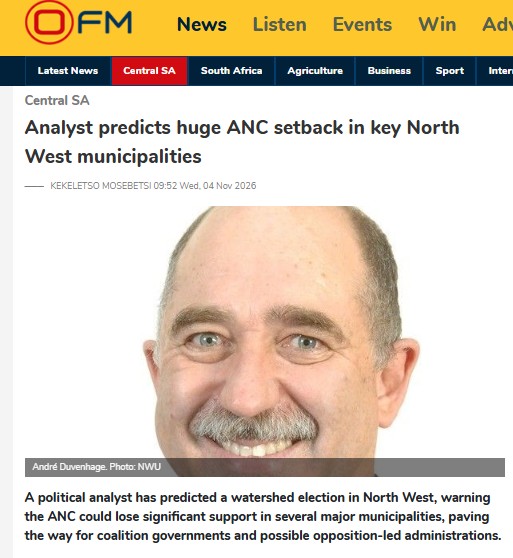
With parties required to negotiate governing arrangements, North-West University political analyst André Duvenhage said the coming days will require difficult decisions, formal alliances and compromises. “This is going to be a difficult time; it’s a time where decisions need to be taken, alliances formalised and agreements formed.”
Possible scenarios
“In terms of the macro context, we can have a centre-to-the-left scenario where the ANC is at the core, involving parties like the MK, EFF, SACP, ACT, including ActionSA. This is likely in many environments.” One possible arrangement could involve a centre-left coalition with the ANC at its core, supported by parties such as the MK Party, EFF, SACP, ACT and ActionSA.
Duvenhage also said despite resistance between the two parties, the ANC and DA could also consider strategic negotiations in certain municipalities. The ANC’s decline follows years of public frustration over poor service delivery, corruption and unemployment, with communities continuing to face water and electricity challenges.
President Cyril Ramaphosa has acknowledged the party’s declining support, describing the election outcome as concerning. “It is a decline that is concerning; that is how I characterise it.”
Ramaphosa has also urged political parties to accept the election outcome and prioritise the needs of communities as they negotiate the formation of new municipal governments.
In the Free State, the ANC is projected to receive 38.68% of the vote, followed by the DA at 27.47%. Other parties combined account for 8.60%, while the FF Plus and EFF are projected to receive 7.41% and 7.37%, respectively.

In North West, the ANC is projected to receive 45.42%, followed by the DA at 14.96%. The EFF registers 11%, ActionSA 6.95%, and the FF PLUS 4%. In Mangaung, the ANC is projected to receive 36.6% of the vote, with the DA following at 31.5%. The EFF is projected to receive 8.6%, the FF PLUS 6.1% and the Patriotic Alliance 3.8%.
OFM News/Kekeletso Mosebetsi dg
• Have a news tip to share? Phone or whatsapp the OFM News Hotline on 066 487 1427.



