
South Africa
Calls grow for coordinated national Foetal Alcohol Spectrum Disorder strategy─── ZENANDE MPAME 15:52 Tue, 08 Sep 2026

“Roughly one in ten South African children is estimated to live with Foetal Alcohol Spectrum Disorder (FASD), yet the country still lacks a dedicated, coordinated national response,” said Rethink Your Drink project lead Kashifa Ancer.
Calls are growing for South Africa to adopt a coordinated national strategy to prevent FASD, shifting the focus beyond simply warning pregnant women about the dangers of alcohol. Researchers and advocates say stronger policies, healthcare support, and community interventions are needed to address the environments that contribute to alcohol-related harm.
They further warn fragmented efforts across health, education, and social services are failing to adequately prevent the condition and address its lifelong consequences.
The term FASD refers to the wide range of physical, behavioral, and cognitive impairments that occur due to alcohol exposure before birth. These impairments may appear at any time during childhood and last a lifetime.
The World Health Organisation states FASD is 100% preventable because it is caused entirely by prenatal alcohol exposure.
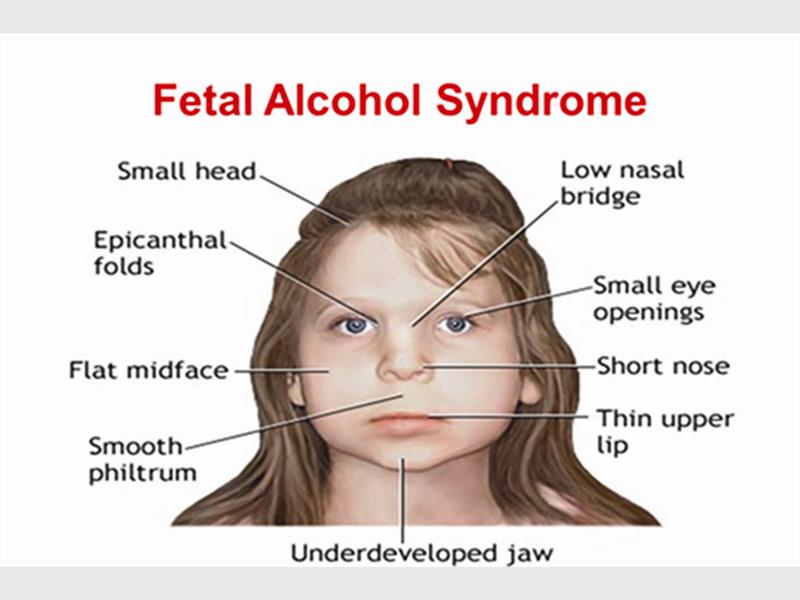
Characteristics of a child with Foetal Alcohol Syndrome. Photo: World Health Organisation
The country has the highest prevalence of FASD in the world, with roughly one in ten children affected. In some communities, particularly in the Western Cape and Northern Cape, prevalence is significantly higher, reaching nearly one in three and one in five children.
Lessons from South Africa’s response to HIV could help shape a system that supports women and families, rather than placing the burden of prevention on individuals alone. “FASD touches so many different aspects of society that it cannot be placed neatly into one government department. Health, social development and education all have a role to play.”
“We need to look at policies through a child’s lens and ask whether the environments we are creating are safe, healthy and welcoming for children. A child has no control over who they are born to or where they are born, but what we can control is the environment they are born into.
“South Africa’s HIV response showed us that prevention improves when systems change, not simply when individuals are told to change. Information alone is not a prevention strategy. Behaviour change is important, but it needs to be supported by strong policies that make healthier choices possible.”

Similar principles could be applied to FASD prevention by creating systems that support women, families, and children, rather than simply telling pregnant women not to drink, she said.
These issues will form part of The First Home, an exhibition hosted by Rethink Your Drink at Cape Town’s Homecoming Centre on Wednesday (9/9). The exhibition combines art, history, lived experience, and policy to encourage visitors to consider how environments influence alcohol use and child health.
• Have a news tip to share? Phone or whatsapp the OFM News Hotline: 066 487 1427.