
Central SA
Health experts urge South Africans to know their hepatitis status─── ZENANDE MPAME 14:05 Mon, 03 Aug 2026

Health experts are urging South Africans to know their hepatitis status and seek early testing to prevent serious liver damage.
As World Hepatitis Day was observed on Tuesday, 28 July, health experts are urging South Africans to learn the facts, understand their risk and consider testing, as early detection can prevent serious liver disease and save lives.
World Hepatitis Day raised awareness of viral hepatitis, an inflammation of the liver that can cause severe liver disease and liver cancer.
Viral hepatitis can damage the liver for months or even years before symptoms appear, leaving millions of people around the world unaware that they are infected.
The 2026 theme, Hepatitis: Let’s Break It Down, calls for barriers preventing people from accessing life-saving prevention, testing, treatment and care to be removed.
“Hepatitis can remain silent for years, which is why awareness and early testing are so important,” said SANBS Free State and Northern Cape head of donor relations Jana Wallace. “The only way to know your hepatitis status is through testing.
“At SANBS, every donated unit is tested for infections including hepatitis B and C to help ensure a safe blood supply.
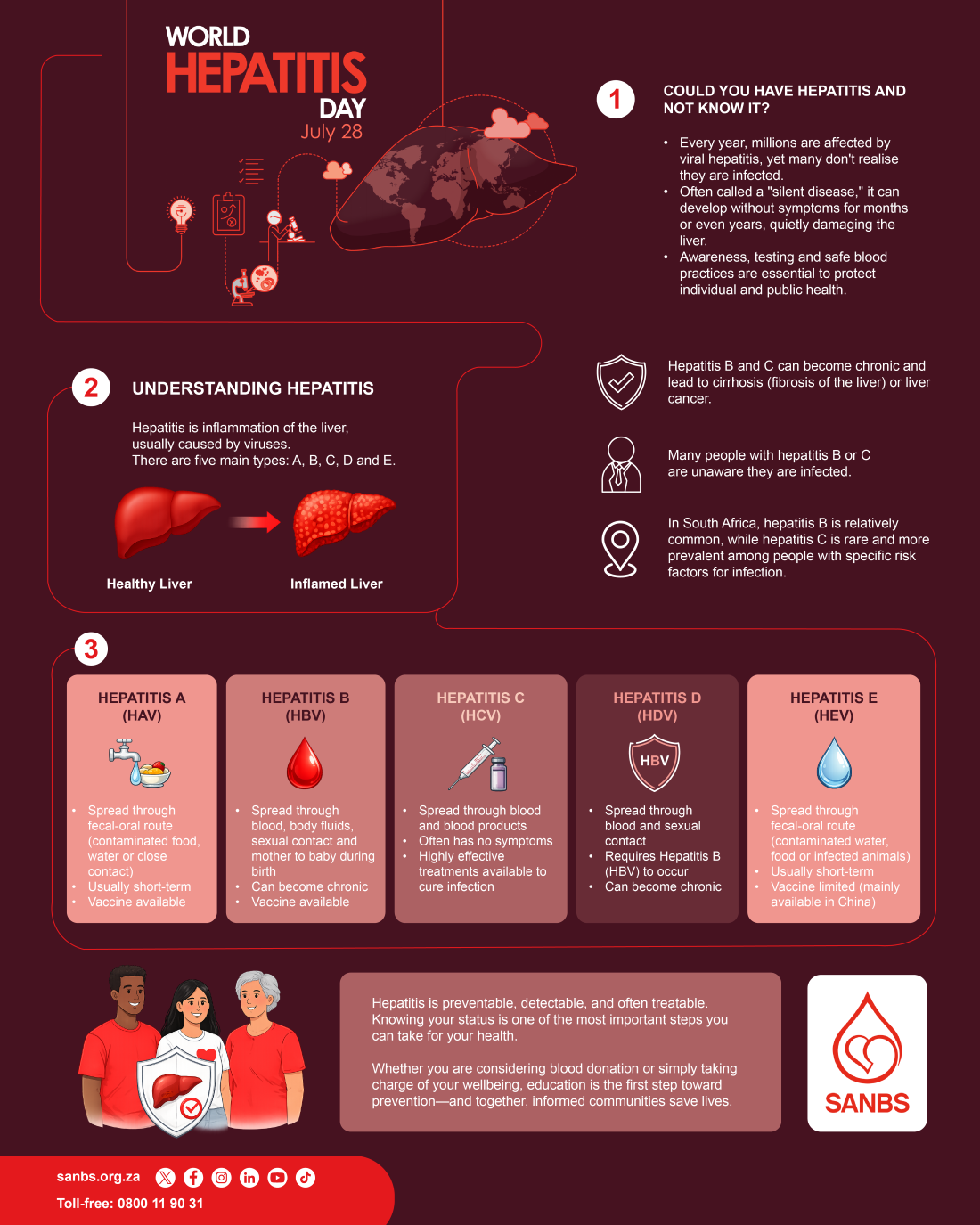
At SANBS, every donated unit is tested for infections including hepatitis B and C. Photo: sanbs.ac.za
“This World Hepatitis Day, we encourage all South Africans to learn the facts, know their status and take charge of their health because knowledge saves lives.”
There are five main types of viral hepatitis: A, B, C, D and E, which are spread in different ways. Hepatitis A and E are generally associated with contaminated food or water, while hepatitis B and C can become chronic infections and cause serious liver damage over time.
Hepatitis D only occurs in people who are already infected with hepatitis B.

When symptoms do appear, they may include:
- persistent fatigue;
- fever;
- loss of appetite;
- nausea and vomiting;
- pain in the upper right side of the abdomen;
- dark-coloured urine;
- pale or clay-coloured stools; and
- yellowing of the skin and eyes (jaundice).
SANBS acting medical director Dr Ute Jentsch said education was crucial because many people did not realise they could be infected with hepatitis B or C.
Effective vaccines, accurate diagnostics, curative treatments for hepatitis C and lifelong therapies for hepatitis B already exist, but stigma, limited awareness, health-system gaps and inequalities continue to prevent many people from accessing care, she said.
• Have a news tip to share? Phone or whatsapp the OFM News Hotline: 066 487 1427.